
by Fr George Kwari
A perceptive journalist who attended our evensong on the Feast of Dedication Sunday, October 19, 2025, noted that our service uniquely engages all five senses: sight, touch, hearing, smell and taste. From the processions, the rich aroma of incense, the genuflection, the melodic hymns--every element contributed to a profound spiritual atmosphere.
However, for new members and first-time guests, all this body, soul and mind-engaging liturgy might feel overwhelming. Practices such as the signing of the cross, kneeling and standing, genuflecting, bowing down, and with the vision of smoke drifting through the sanctuary leaving sacred ministers covered in a cloud of smoke, can leave first-time guests puzzled.
Bearing all this in mind, how do we break it down to a level that new members can easily transition and navigate our cherished practices.
Let us begin by entering the church where you will find bowls of holy water. People are invited to dip their fingers and ✠ make a sign of the cross. This act is not merely ritualistic. Holy water is water which has been solemnly blessed with the petition that wherever it may be sprinkled, God’s protection may rest. Therefore, to use it is to apply this solemn petition to that upon which it is cast; it forms in fact an act of prayer.
When leaving, the same gesture serves as a moment of prayer, solidifying one’s connection to the divine.
As you enter the church it is customary to GENUFLECT slightly while facing towards the AUMBRY where the Blessed Sacrament is kept. Genuflection is a sign of reverence.
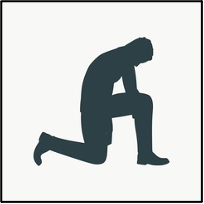
To genuflect you should touch the ground with your right knee at the spot where the right foot was, for the blessed sacrament. Use your left knee for a diocesan bishop or human dignitary.
Should genuflecting be difficult to do because of physical limitations, a deep bow with hands touching the knees suffices—God understands our individual circumstances.
A genuflection is also used on the following occasions:
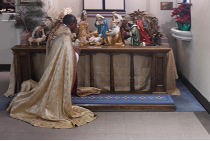
- upon exiting the church.
- to reverence the blessed sacrament during Mass.
- as reverence made to the unveiled cross on Good Friday
- to reverence the crib at Christmas as it were to visit the manger at Bethlehem.
THE ✠ SIGN OF THE CROSS will be made several times throughout the service.
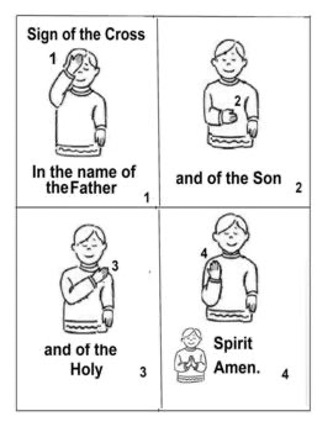
To make the sign of the cross, use your right hand to touch your forehead, then your heart, followed by your left shoulder and finally your right. This movement creates a horizontal line and a vertical line, forming a cross.
During the processional hymn, or Asperges Me outside Easter Season or Vidi Aquam (Easter Season), the celebrant sprinkles you with holy water. The congregation responds by making the sign of the cross as a nod to the purity of baptism and the new life found in Christ.
At the APOSTOLIC GREETING the celebrant says, “The grace of our Lord Jesus Christ and the love of God and the fellowship of the Holy Ghost be with you. And the congregation responds with the sign of the cross saying “Amen.”
The Glory to God (GLORIA) has three main sections.
The first part begins with the angels greeting to the shepherds, “Glory be to God on High…”
The second part begins with the praise of God the Father and the next part takes us to the Jesu, the Son. Each has its importance and needs to be understood. Gestures go with each segment.
BOWING takes place at certain specific occasions, namely:
- We praise thee, we bless thee, [bow] we worship thee,
- O Lord, the only-begotten Son, [bow] Jesu Christ.
- Thou that takest away the sin of the world, [bow] receive our prayer.
- Who with the Father and the Son together is [bow] worshipped and glorified
We also make the sign of the cross at the mention of the Trinity. “Thou only art the Lord; thou only, O Christ, with the Holy Ghost, ✠ (make a sign of the cross) art the most high in the glory of God the Father. Amen.”
Before the gospel reading, the SIGN OF THE CROSS is made in rather a different manner. During the Acclamation, the gospeller and the congregation trace small crosses on their ✠ foreheads, ✠ lips, ✠ chest symbolizing our desire for the Gospel to illuminate our minds, hearts and lips. Commonly known as “Triple sign of the Cross”
As the service progresses, we all stand to affirm our baptismal faith, using the NICENE CREED. The creed is one of our cornerstones, summarizing our Christian faith from creation, the Triune God, the incarnation, death and resurrection, the remission of sins, the acknowledgment of our baptism, and the gift of eternal life. It is appropriate that, through this acknowledgment, certain gestures accompany our words.
It is customary to KNEEL throughout the phrase “And was incarnate by the Holy Ghost of the Virgin Mary, and was made man” in thanksgiving for the Incarnation.
One parishioner once said that on their first Sunday here they saw someone ‘going to the ground’ on those words and thought they had fainted. Later on, they realized they had not fainted but they were genuflecting.
KNEELING
There are several places when we KNEEL during the service especially during the collect of the day, prayers of the people, confession and absolution, prayer of consecration, prayer of humble access, Agnes Dei, receiving the body and blood of Christ, when the Sacrament is exposed in the monstrance and receiving the blessing.
From the prayers of the people, the service continues with the CONFESSION AND ABSOLUTION. When the celebrant pronounces the words of absolution, “Have mercy upon you; ✠ pardon and deliver you from all your sins, confirm and …”. We respond by making the sign of the cross again.
Canon of the Mass
From there the liturgy progresses into the HOLY EUCHARIST segment. We introduce it with the sursum coda, preface and then at the Sanctus and the Benedictus we kneel. At the beginning of the Benedictus as we sing, “Blessed is he that cometh in the name of the Lord…” we make the sign of the cross at that time.
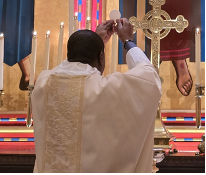
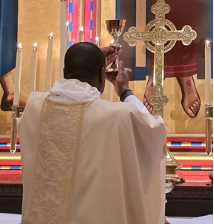
During consecration the priest genuflects and adores the body/blood of Christ, then elevates the host/chalice; there you may make the sign of the cross ✠ and pray in your heart, “My Lord and my God”, acknowledging the profound gift of love that was poured out for our salvation. And at communion before receiving the Body of Christ and the Blood of Christ we make the sign of the cross again.
As the BLESSING is pronounced, you kneel and make the sign of the Cross.
At the conclusion of our service, as we prepare to depart, we are invited to make the sign of the cross once more, a final reminder that we are sent forth to share the good news of Jesus Christ with the world. Each time we respond, “✠ Thanks be to God,” we make the sign of the cross and we affirm our commitment to live as witnesses of the cross, carrying its message of hope into our daily lives.
I am sure more can be said about our liturgy and I will leave that to you.
Source: Anglican Services-A book concerning ritual and ceremonial in the Church of England
First published July 1953